
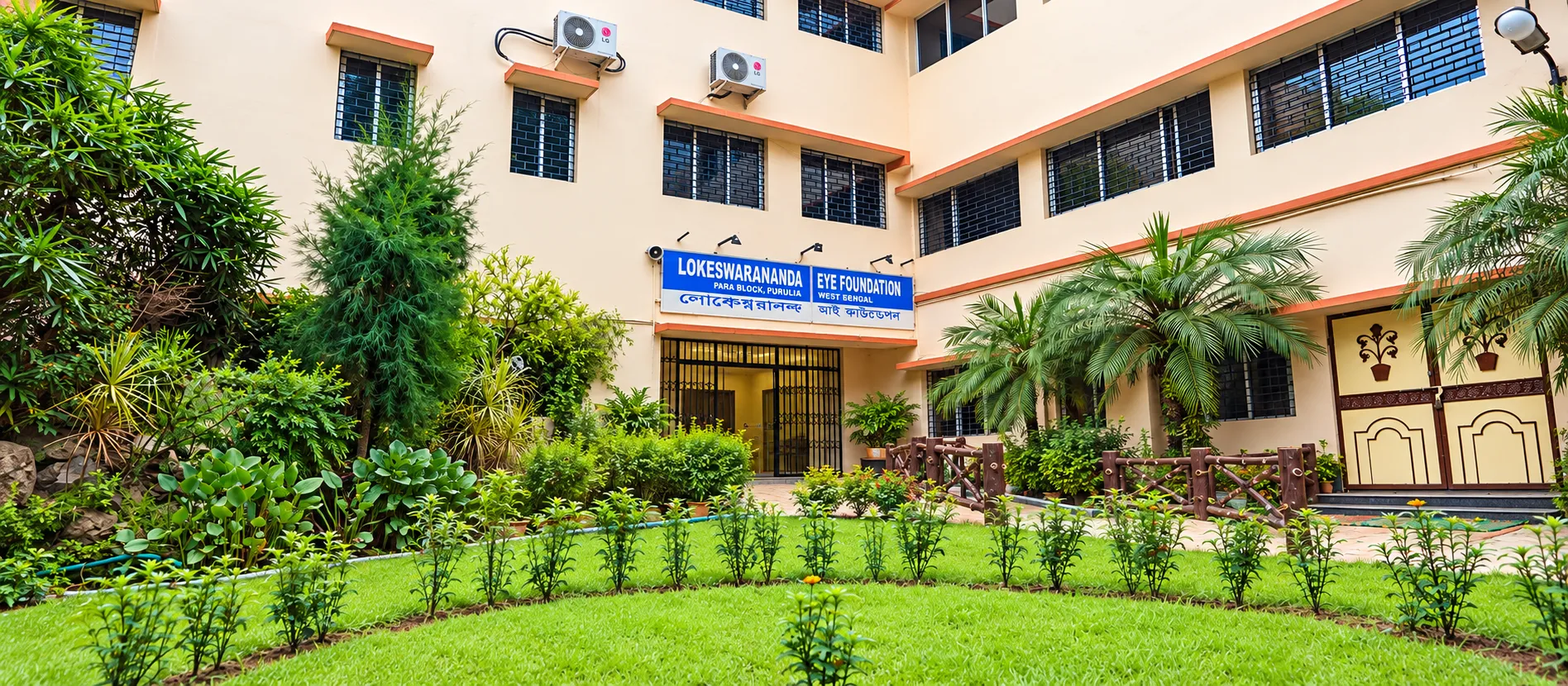
Service to Man is Service to God
Lokeswarananda Eye Foundation’s next phase of development will strengthen the facilities, technology and skilled workforce needed to make quality eye care accessible to more people.
Our proposed three-year programme combines 50,000 sq. ft. of residential and training infrastructure, modernisation of existing operation theatres, advanced ophthalmic equipment, improved patient support and development of our Purulia town clinic into an inpatient eye-care facility.
The expansion will support LEF’s continuing commitment to free, subsidised and paying care, with financial hardship never becoming a barrier to treatment.
Suitable accommodation and opportunities for professional development will help LEF attract and retain doctors, nurses, technicians and visiting faculty in rural Purulia.
| Component | Proposed area | Planned facilities |
|---|---|---|
| Doctors’ quarters | 10,000 sq. ft. | Approximately 10 apartments with living facilities, workspaces and shared amenities |
| Nurses and technicians | 10,000 sq. ft. | Accommodation for approximately 30–40 staff, with common rooms, sanitation and storage |
| Training and shared dining | 15,000 sq. ft. | Classrooms, skills laboratories, digital learning, faculty rooms, dining hall and kitchen |
| Trainee accommodation | 10,000 sq. ft. | Dormitories, study areas, washrooms and common facilities |
| Visiting specialists | 5,000 sq. ft. | Approximately 6–8 studio units with shared lounge facilities |
| Total | 50,000 sq. ft. | Integrated residential and training campus |
Areas and accommodation capacities are proposed and will be refined through architectural design. The dining hall and kitchen are included within the total area.
The proposed training centre will give students and practising professionals dedicated spaces to learn and practise alongside an operating eye hospital.
Training priorities will include ophthalmic assistance, refraction, community screening, patient counselling, OT support and nursing skills. Specialist workshops, supervised clinical attachments and observerships will be developed with suitable faculty and institutional partners.
The longer-term ambition is to support 100–150 trainees annually, with intake expanded according to faculty availability, facilities and applicable course requirements.
LEF plans to convert its three existing conventional operation theatres into modular theatres, bringing the total to five modular OTs after completion. Work will cover suitable theatre surfaces, ventilation and filtration, electrical systems, emergency-power connections, scrub facilities and sterile circulation.
Upgrades will be undertaken in stages to maintain surgical services. Each theatre will undergo technical checks and a clinical readiness assessment before use.
| Service area | Proposed equipment |
|---|---|
| Cataract | Phacoemulsification machines, operating microscopes, optical biometer and microsurgical instrument sets |
| Retina | OCT system, fundus camera, vitreoretinal surgical platform and retinal laser |
| Glaucoma and cornea | Visual-field analyser, tonometers, pachymeter, corneal topography and specular microscopy |
| General and paediatric care | Slit lamps, autorefractor-keratometers, ultrasound, retinoscopes, ophthalmoscopes and orthoptic assessment equipment |
| Surgical support and sterilisation | Operating tables or chairs, monitors, suction, emergency support, autoclave, instrument-cleaning, sealing and packing equipment |
| Training | Teaching microscopes, practice models, simulation aids, computers and classroom displays |
Final quantities will follow a review of existing equipment, condition and service needs. Procurement will include installation, staff training and maintenance planning.
LEF has already established a clinic in Purulia town to make consultations and follow-up more convenient. The next phase proposes developing this clinic into an inpatient eye-care facility.
Bed capacity and clinical services will be determined after assessing the premises, staffing and operational requirements.
The plan includes two patient transport vehicles, introduced in phases, to support travel for treatment, discharge and scheduled follow-up. Transport will be coordinated with community partners and referral teams to help patients who face difficulties reaching hospital services.
Outreach surgery will continue through existing hospital eye operation theatres. LEF’s doctors, nurses and support staff will work alongside host hospitals and local volunteer organisations. Follow-up will be provided by local doctors where available, or through returning LEF teams.
A shared dining hall and kitchen will support staff, trainees and visiting clinical teams, with arrangements for patient attendants. The facilities will include cooking, washing and storage areas and suitable dining furniture.
A dedicated laundry unit will provide appropriate washing, drying, finishing and storage facilities. Hospital linen will follow a controlled workflow separating soiled and clean materials. Capacity will be based on measured demand, with provision for future growth.
The development will include improvements to electrical distribution, backup power, water treatment, drainage, fire safety, accessibility and digital connectivity. Solar support will be assessed as part of the campus energy plan. These services will be designed around new facility requirements and the capacity of existing systems.
Complete designs and equipment review; begin residential and training construction; start phased OT upgrades; procure priority equipment; establish laundry services and introduce the first patient vehicle.
Progress campus construction; complete theatre conversions; install advanced equipment; develop dining and training facilities; introduce the second vehicle; undertake Purulia inpatient facility fit-out.
Complete the campus programme; commission remaining facilities; begin Purulia inpatient services when ready; consolidate training, staffing and maintenance arrangements.
Implementation will follow funding availability, technical approvals and the need to maintain patient services throughout construction. New clinical facilities will open when the required staff, equipment and operating arrangements are ready.
Each new facility will have an operating plan covering staff, consumables, maintenance, utilities and replacement needs. LEF will monitor facility use, equipment downtime, training completion, referral and follow-up, and service outcomes by location.
Our aim is to build the people, facilities and systems that will keep quality eye care within reach for generations to come.